
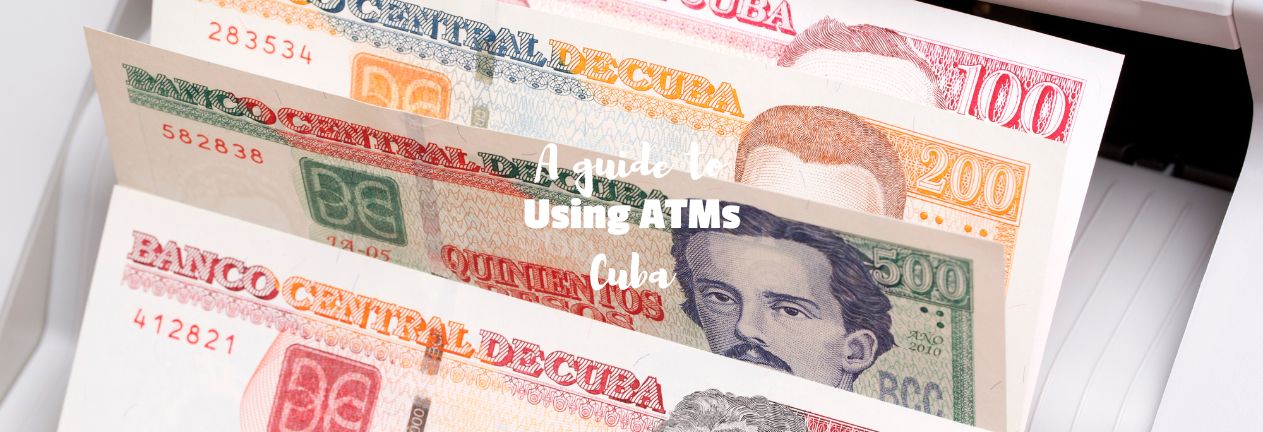
ATMs in Cuba do exist. They are not mythical. They are not reserved for locals only. And yes, some foreign cards do work. But relying on Cuban ATMs as your main plan for accessing money is where many travelers to Cuba go wrong. Machines run out of cash. Power cuts shut them down. Cards are declined without explanation. And even when everything works perfectly, you receive the official government exchange rate, which is rarely the most favorable option available. So let’s go through what you can realistically expect if you plan to use ATMs in Cuba in 2026.
THIS POST MAY CONTAIN COMPENSATED AND AFFILIATE LINKS. MORE INFORMATION IN OUR DISCLAIMER
Let’s clear up one misnomer. There are ATMs in Cuba. There are more than 900 ATMS in Cuba. You’ll find them all easily by sticking in “ATM” as a search on either Maps.me or Google Maps. And this post isn’t about showing where all the ATMs in Cuba are.
This is about what you can expect at ATMs in Cuba, what the fees are for ATMs in Cuba, withdrawal limits, withdrawal challenges, and all the associated details with that.
I do NOT recommend that you use ATMS in Cuba; there are better ways to pay for things in Cuba, but this post is designed to answer all the questions I get about using ATMs in Cuba.
PRACTICAL TRAVEL TIPS
- 🛡️ Get Travel Insurance: Civitatis includes medical expenses, repatriation, theft, luggage delays. No deductibles or upfront payments. Get a quote here. .
- 🛂💻 Buy your Cuba eVisa here.
- 🔌 Be ready for the plug, socket & power situation.
- 📶 Internet, maps, data on the go. Buy an eSim for Cuba. Or pre-order a physical SIM card
- 🔒 Do NOT leave home without a VPN. Buy for your trip here.
What you need to know about ATMs in Cuba in 2026
So, as I’ve said, ATMs are available (but often run out of cash, have long lines, or just don’t work), but aside from these fundamental factors, there are other reasons not to use ATMs in Cuba. I’ll cover those shortly. Let’s cover the main questions asked about Cuban ATMs first.
What Currency do Cuban ATMs dispense?
Cuban ATMs dispense Cuban Pesos (CUP) only. They do NOT dispense any other currency. You cannot withdraw US Dollars, Euros, Canadian Dollars, or any other foreign currency from an ATM in Cuba.
What Exchange Rate do you get at a Cuban ATM?
When you withdraw CUP at an ATM in Cuba, you will receive CUP at the official government exchange rate.
You should know that in Cuba, from 18th December 2025, there are THREE official CUP exchange rates.
ATM’s dispense cash at the fixed rate of US$1 = CUP120 in Cuba in 2026. You NEED to read on for more detail as to why this matters, but first
What are the Government exchange rates in Cuba?
There are three different exchange rates used by the Government in Cuba.
- The fixed rate of US$1 to CUP24 (this is for centralized state allocations for goods and services considered essential, such as fuel, medicine, electricity, public transportation, and basic necessities)
- The fixed rate of US$1 to CUP120 (this is for certain entities with the capacity to generate foreign currency, particularly in the tourism sector)
- The new floating rate (which is what most of the rest of the world uses), which was launched on 18 December 2025 at US$1 to CUP410. This is for individuals and non-state management entities. An update to this rate is published every day by Cuba’s Central Bank (BCC). You can find it here.
ATM’s dispense cash at the fixed rate of US$1 = CUP120 in Cuba in 2026. You NEED to read on to understand the issues with this.
If you take your card inside a Cadeca or Bank and ask for a cash advance of Cuban Pesos you will get the floating rate. e.g. the daily rate, which is currently MORE THAN THREE TIMES better than the ATM dispensing rate.
If you’ve read my main guide to Cuban currency, you’ll know that the exchange rate you use makes a significant difference to how expensive Cuba feels.
Withdrawal Limits at Cuban ATMs
Most Cuban ATMs have a daily withdrawal limit, which has been set as low as 5,000 CUP in past months. That’s about the average monthly income for many Cubans. At the set rate of US£1 – CUP120, this is about US$42.
If you change US$42 at a Cadeca, with cash or using a card for a cash advance, or on the informal market, then you’ll get (at today’s rate) more than 22,000 CUP.
Infrastructure Issues with Cuban ATMs
While ATMs might be provided by different banks in Cuba, Banco Metropolitano, for instance, has just over 500 machines; the background infrastructure is managed by the state-owned company REDSA. “Essential maintenance” is frequent, and this shuts down the entire national system. It’s rarely planned; it just happens.
And then there’s the technology and the spare parts requirement for operating the ATMs themselves. There are fewer ATMs that actually work now than there were a few years back because of not being able to get hold of spare parts.
Frustration also forms a part of the infrastructure issue with Cuban ATMs. Acts of vandalism, perhaps perpetrated by frustrated queuers who got to the front to find no cash, no power, or whatever, mean that many ATMs were relocated inside the actual bank branch. And of course, that means that the ATMs are therefore subject to banking hours.
Guides to Currency, ATMs, budgeting, and paying for things in Cuba
I’ve got a lot of content here on Cuba’s Best about traveling to Cuba. And there’s a lot of content about currency, paying for things, and how cash in Cuba works. Here’s the specific detail about that.
- An overview of Cuban Currency in 2026
- Using ATMs in Cuba
- What Currency to Take to Cuba in 2026
- How to send money to Cuba in 2026
- How much money to take to Cuba in 2026
- A brief recent history of the Cuban Currency
- What to do if you run out of cash in Cuba
- Cash v’s Cards in Cuba
- Understanding the Informal Currency Exchange in Cuba.
FAQs about ATMS in Cuba
I think this entire post is just a series of questions about Cuban ATMs, but here are a few more for you. If you’ve got a question that I haven’t answered, drop me an email hello [at] cubasbest.com
Are there ATMs in Cuba?
Yes. There have been ATMs in Cuba since 1997, which might seem strange, seeing as they’ve been in London, England, since 1967 and in Chile since 1984. But hey, this is Cuba.
And anyway, you’ll find ATMs at Havana’s Airport, and throughout the cities of Cuba – from Havana to Varadero, Santiago de Cuba, Trinidad, and other major cities and provincial capitals. Not so many in the smaller towns, but near to major hotels and central squares.
I’ve only had one instance where the ATM didn’t work (this is going back a long time), and that was because my debit card had been stopped by my bank, and I didn’t know. Of course, this is a challenge when internet access is poor (read about how to get internet in Cuba here ), and my cell phone didn’t work either. It’s easier to buy a tourist SIM or esim for better internet access. – There’s more on that here. You’ll want to ensure that you have an ATM card that works in Cuba. Check with your provider before traveling.
Do foreign cards work in Cuban ATMs?
Yes and no. It depends on where your card was issued and a few other factors. If your card was issued by a US bank, it will not work. There are no exceptions to this. If your card was issued outside the United States, there is a possible chance it will work.
Most European, Latin American, Asian, Australian, New Zealand, and Canadian bank cards WILL work in Cuban ATMs – but check for your particular bank.
The following branded cards WORK in Cuba – but cards from some bank providers might not – take a backup card and check with your provider before traveling.
- Visa
- Mastercard
- Union Pay
Which foreign cards do NOT work in Cuban ATMs?
American Express cards do not work in Cuban ATMs. Wise cards do not work in Cuban ATMs. Revolut cards do not work in Cuban ATMs. Travelex, Citibank, Westpac (Australia), St George (Australia), and 28 Degrees cards do not work in Cuban ATMs. Cirrus and Switch do NOT work in Cuban ATMs.
Even with a compatible card, you should always check with your bank before traveling. Some banks block transactions to Cuba automatically due to sanctions compliance.
Why do ATMs in Cuba run out of cash?
This happens often enough to make it a big issue. They run out of cash because people want (and need) cash. There is usually high local demand, especially around weekends and public holidays. People (locals and visitors) plan around Cuba’s power outages. (Read about issues with fuel shortages in my guide here)
How Power Outages Affect ATMs
Cuba continues to experience rolling power outages throughout the country. There is no sign of this abating. It’s been going on for years now. And when the electricity goes out, ATMs stop working. This is one of the main reasons I recommend never relying solely on ATM access during your trip. If you’re in a smaller town during an outage, there may be no functioning machines at all.
When Does It Make Sense to Use an ATM in Cuba?
It doesn’t is the short answer.
The longer answer is, well, in an emergency. I.e. you’ve run out of cash. You have NO OTHER WAY of getting hold of money. Because the US$1 to 120 CUP exchange is SO BAD compared to your other options, you’ll end up leaving Cuba thinking it was an incredibly expensive country to visit.
Even then, when you think you have no other option, actually, you have. You can probably send money to someone electronically, and they can send it to you. Or you can send it to yourself. I wrote about sending money to Cuba here.
Which is the best ATM in Cuba?
The only serious answer to this is one that both works and has cash inside it. Be conscious of weekends, holidays, and potential power cuts, and always plan when it comes to cash in Cuba. There are often rolling power outages throughout Cuba, so don’t rely on arriving somewhere and finding an ATM that is working.
CUBA TRAVEL RESOURCES
CUBA BY BUS EBOOK
Buy our Ebook. Preplanned itineraries, themed routes, exact instructions for an easy visit.
Buy Cuba by Bus
BEST
CASA PARTICULARS
See choices here
Luxury rooms? Budget rooms? Laundry? Best room choice & Great hosts.
TOURS & ATTRACTIONS
Top daytrips, small group tours, tickets, pay online easily with free cancellation and top local guides.
Top options here.
TRANSFERS & TAXIS
Read my Guide
Go from A to B easily. Sightsee along the way. Maximise your time in Cuba.
Final Words on ATMs in Cuba in 2026
Yes, there are ATMs in Cuba. Yes, ATMs work in Cuba. Sometimes. Foreign cards sometimes work. The ATMs sometimes have cash. The ATMs sometimes have power. But Cuban ATMs operate at a poor official exchange rate, are vulnerable to outages, and cannot be relied on at all. If your entire trip depends on finding a working ATM that works in Cuba, then I suggest you rethink your visit and always plan two or three steps ahead when it comes to money in Cuba.
Cuba’s Best is a participant in the Amazon Services LLC Associates Program, an affiliate advertising program designed to provide a means for sites to earn advertising fees by advertising and linking to amazon.com, amazon.co.uk, amazon.ca. Amazon and the Amazon logo are trademarks of Amazon.com, Inc. or its affiliates.
